Adaptive Cruise Control: What It Is, How It Works, and Cost
Adaptive cruise control automatically adjusts your car's speed to match traffic ahead while maintaining a safe following distance. Unlike traditional cruise control that simply holds a set speed, this system uses sensors and cameras to monitor surrounding vehicles and responds by slowing down or speeding up as needed. It's designed to reduce driver fatigue on highway trips and make stop-and-go traffic less stressful.
Click here to see our inventory equipped with Adaptive Cruise Control or Forward Collision Monitoring
This guide walks you through everything you need to know about adaptive cruise control. You'll learn how to activate and use the system, understand the technology behind it, and discover key differences from standard cruise control. We'll also cover the pros and cons, safety limitations to watch for, typical costs when buying a car, and what to look for when shopping for used vehicles with this feature. By the end, you'll know whether adaptive cruise control is worth the investment for your driving needs.
Why adaptive cruise control matters
Your daily commute and road trips become significantly less exhausting when you don't have to constantly adjust your speed manually. Adaptive cruise control takes over the repetitive task of monitoring traffic ahead and making speed adjustments, which means you can focus more attention on steering and watching your surroundings. This technology transforms hours of highway driving from a tiring chore into a more relaxed experience, particularly on routes with variable traffic patterns.
Reduces driver fatigue on long trips
Long-distance driving demands constant vigilance, and traditional cruise control forces you to disengage the system every time traffic slows down. You'll spend less energy on long highway stretches because the system handles speed adjustments automatically when vehicles merge into your lane or slow down ahead. This reduction in physical and mental strain helps you arrive at your destination feeling more alert and less drained from the journey.
Drivers who use adaptive cruise control on extended trips report feeling more refreshed and less mentally exhausted than those who manually control their speed throughout the journey.
Improves safety in traffic
Traffic accidents often happen when drivers fail to notice slowing vehicles quickly enough or misjudge following distances during distracted moments. Adaptive cruise control maintains consistent spacing between your vehicle and the car ahead, which gives you a crucial safety buffer if traffic suddenly stops. The system reacts faster than human reflexes in many situations, applying brakes smoothly before you might even notice the need to slow down. Studies show that vehicles equipped with this technology experience fewer rear-end collisions, particularly in highway traffic where speeds vary frequently. Your chances of avoiding accidents improve because the system never gets distracted, tired, or delayed by reaction time the way human drivers do during long periods behind the wheel.
How to use adaptive cruise control
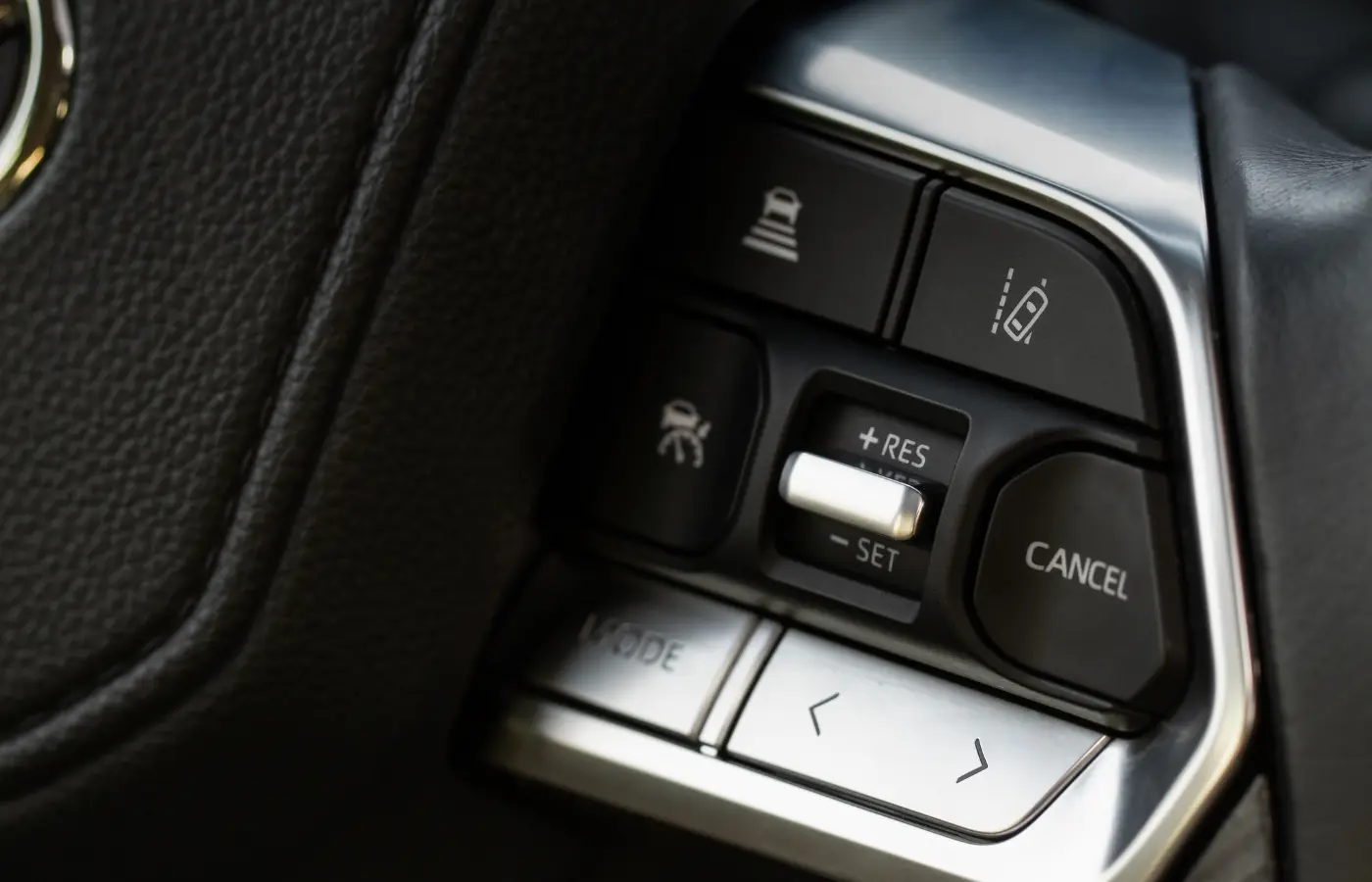
Activating adaptive cruise control requires just a few button presses once you know where to look, though the exact process varies slightly between different vehicle manufacturers. Most systems place the control buttons on your steering wheel or on a stalk near the turn signal, making them easy to reach without taking your hands off the wheel. You'll find symbols like a speedometer icon with an "A" or a car with radiating lines indicating the adaptive feature, which differs from the simple speedometer icon used for standard cruise control.
Finding and activating the system
Your vehicle's steering wheel typically holds the adaptive cruise control buttons on the right side, either integrated into the wheel itself or mounted on a separate stalk. Look for buttons labeled "SET," "RES" (resume), "CANCEL," and distance adjustment controls marked with car icons showing different spacing levels. Press the main cruise button to turn the system on, which usually illuminates an indicator light on your dashboard. You need to accelerate to your desired speed manually first, then press "SET" to engage the system at your current speed. Most systems only activate above 20-25 mph, though some newer versions work in stop-and-go traffic down to 0 mph.
Setting your speed and following distance
The system maintains whatever speed you've set when you press the "SET" button, and you can adjust this speed using the plus or minus buttons in small increments. Tap the plus button once to increase by 1 mph, or hold it down to accelerate continuously until you release it. Your following distance settings appear as bars or numbers on your dashboard, typically offering three to four spacing options ranging from close (about 1.5 seconds) to far (about 3 seconds). You change the distance by pressing the gap or distance button repeatedly to cycle through available options.
Choosing a longer following distance gives you more reaction time if the system needs to brake suddenly or if you need to take control manually.
Adjusting or deactivating while driving
Pressing the accelerator pedal temporarily overrides the system without disengaging it, allowing you to pass slower vehicles or merge into faster traffic. The system resumes maintaining your set speed and distance once you release the accelerator. You can deactivate adaptive cruise control instantly by tapping the brake pedal or pressing the "CANCEL" button, which immediately returns full speed control to you. The "RES" button reactivates the system at your previously set speed after you've canceled or braked, saving you from having to manually accelerate back to your preferred cruising speed on the highway.
How adaptive cruise control works
Your vehicle uses a combination of sensors and computer processing to detect other cars, measure distances, and adjust speed automatically without any input from you. The system constantly scans the road ahead using radar waves, cameras, or laser technology mounted in your front bumper or behind your windshield. These sensors feed real-time data to your car's onboard computer, which calculates how fast other vehicles are moving and how far away they are. The computer then decides whether to maintain your current speed, slow down by reducing throttle, or apply the brakes to keep a safe following distance from traffic ahead.
Sensor technology that monitors traffic
Radar-based systems send out radio waves that bounce off objects in front of your vehicle and return to sensors, typically hidden behind your front grille or bumper cover. This technology works well in rain, fog, and darkness because radio waves penetrate weather conditions that would blind cameras. Your car might also use cameras mounted near the rearview mirror that visually identify vehicles, lane markings, and road signs using image recognition software. Some manufacturers combine both radar and cameras in what's called a multi-sensor system, which provides more reliable detection than either technology alone. Laser-based systems, though less common now, use infrared light pulses to measure distances with extreme precision, though they struggle during heavy rain or snow when water droplets scatter the laser beams.
Speed and distance calculations
The system measures how quickly the gap between your car and the vehicle ahead is changing, which tells it whether that car is slowing down, speeding up, or maintaining steady speed. Your car's computer processes dozens of these measurements every second to predict what will happen in the next few moments. The system also tracks your set speed and compares it to your current speed, determining how much it needs to accelerate or decelerate to maintain the following distance you selected. Some advanced systems can even predict when a car in an adjacent lane might merge in front of you by detecting turn signals or observing the vehicle's trajectory angle.
Modern adaptive cruise control systems process sensor data 10 to 20 times per second, allowing them to react to traffic changes faster than most human drivers can perceive and respond.
When calculating safe distances, the system factors in your current speed since higher speeds require longer following distances for safe braking. A two-second gap at 30 mph translates to about 88 feet, while the same two-second setting at 70 mph means roughly 205 feet between vehicles. Your selected distance setting determines the minimum gap the system will maintain, and the computer continuously adjusts throttle and brake inputs to preserve that spacing as traffic conditions change.
Automatic acceleration and braking
Your car's adaptive cruise control communicates directly with the engine and brake systems through the vehicle's electronic control network. When the road ahead clears or the vehicle in front speeds up, the system increases throttle gradually to bring you back to your set cruising speed without any jerky acceleration. The transition happens smoothly because the computer calculates the optimal acceleration rate based on how far below your set speed you're currently traveling. Most systems accelerate conservatively to maintain passenger comfort and fuel efficiency rather than trying to reach the set speed as quickly as possible.
Braking happens through the same electronic connection to your anti-lock brake system, allowing the computer to apply brake pressure in measured amounts. Light braking occurs when traffic ahead slows gradually, while harder braking engages if a vehicle cuts in front of you or traffic stops suddenly. The system releases brake pressure smoothly once the gap increases again, creating a seamless transition back to maintaining speed. However, most adaptive cruise control systems have braking limits and will alert you with visual and audible warnings if they detect a situation requiring emergency stopping power beyond their programmed capabilities.
Adaptive cruise control vs cruise control
Traditional cruise control and adaptive cruise control share the same basic purpose of maintaining a set speed, but they function very differently when traffic appears ahead. Standard cruise control keeps your vehicle at whatever speed you programmed, completely ignoring other cars on the road until you manually tap the brakes or accelerator. Adaptive cruise control adds intelligence to this basic concept by monitoring traffic conditions and making speed adjustments automatically to prevent you from getting too close to vehicles ahead.
What traditional cruise control does
Your basic cruise control operates as a simple throttle lock that holds the accelerator at a fixed position to maintain constant speed. The system has no awareness of traffic, curves, hills, or road conditions around you. You must disengage cruise control by pressing the brake pedal every time a slower vehicle appears in your path, then manually accelerate back to your desired speed once the road clears. This constant on-off cycle makes standard cruise control impractical in moderate to heavy traffic, limiting its usefulness to empty highways and rural roads with minimal congestion.
What makes adaptive cruise control different
Adaptive systems continuously scan the road ahead using sensors, automatically slowing down when they detect vehicles in your lane and speeding back up when the path clears. You set both a maximum speed and a following distance, and the system maintains that spacing without any intervention from you as traffic speeds fluctuate. The key difference shows up most clearly in highway traffic where speeds vary frequently. Traditional cruise control forces you to take over manually dozens of times during a typical commute, while adaptive cruise control handles these speed changes automatically. This means you keep cruise control engaged for much longer periods, even in moderately busy traffic conditions that would make standard cruise control unusable.
Adaptive cruise control transforms cruise control from a feature you can only use on empty roads into a system that works effectively in real-world traffic situations where speeds constantly change.
Pros, cons, and safety limits
Adaptive cruise control delivers clear benefits for highway driving and commuting, but the technology has practical limitations that every driver needs to understand before relying on it. The system works best in specific conditions and struggles or fails completely in others. Understanding both the advantages and the boundaries of this feature helps you use it effectively while staying safe on the road. Your car's adaptive cruise control enhances convenience and reduces fatigue, yet it cannot replace your attention and judgment behind the wheel.
Benefits that improve your drive
The most immediate advantage shows up in how much less tiring long highway trips become when you don't manually control speed for hours. Your leg gets a break from constant accelerator pressure, and your mind relaxes slightly because the system handles the repetitive task of matching traffic flow. Fuel economy typically improves because the computer applies throttle and brakes more smoothly than most drivers do manually, eliminating the acceleration-braking cycles that waste gas in moderate traffic. Studies indicate that adaptive cruise control can reduce rear-end collisions by maintaining consistent following distances that human drivers often misjudge or let shrink too small during distracted moments.
Your stress levels drop noticeably in stop-and-go traffic where the system can bring your car to a complete stop and resume movement automatically. This feature transforms gridlock commutes from constant brake-and-gas frustration into a more passive experience where you only steer while the system manages speed. The safety buffer the technology creates gives you extra reaction time if something unexpected happens ahead, since the sensors detect slowing traffic faster than your eyes might notice it during a moment of divided attention.
Limitations to understand
Weather conditions significantly degrade how well adaptive cruise control functions, particularly during heavy rain, snow, or fog when water or ice covers the sensors. Your radar or camera systems can misread distances or completely lose sight of vehicles ahead when precipitation blocks their view. Curvy roads and steep hills challenge the system because sensors point straight ahead and cannot see around tight corners or over crests until vehicles come into their direct line of sight.
Construction zones with lane shifts, unclear markings, or sudden merge patterns often confuse adaptive cruise control systems that rely on clearly painted lanes and predictable traffic flow. The technology also struggles with vehicles that cut into your lane suddenly, motorcycles that weave between cars, or pedestrians and cyclists who appear in unexpected places. Your system needs a clear view and straightforward traffic patterns to work reliably, which means many real-world driving situations fall outside its comfort zone.
When you still need to take control
Most adaptive cruise control systems cannot handle emergency braking situations where you need to stop quickly to avoid a collision. The technology typically alerts you with loud beeping and dashboard warnings when it detects a situation beyond its braking capacity. You must take over immediately when these alerts sound because the system will not apply maximum braking force on its own. Intersections, traffic lights, stop signs, and vehicles turning across your path all require your direct control since adaptive cruise control only monitors traffic moving in your same direction and lane.
Adaptive cruise control assists with highway driving but never replaces your responsibility to stay alert, keep your hands on the wheel, and be ready to brake or steer at any moment.
Your attention remains critical even when the system operates normally because unexpected situations develop faster than any technology can handle. Drivers who treat adaptive cruise control as self-driving automation increase their crash risk substantially compared to those who use it as a convenience feature while staying fully engaged with driving.
Cost of adaptive cruise control
The price you'll pay for adaptive cruise control depends heavily on whether the feature comes standard on your chosen vehicle or sits buried in an optional package with other technology. Manufacturers rarely sell this system as a standalone add-on anymore. Your actual cost ranges from zero dollars on vehicles where it's included as standard equipment to several thousand dollars when bundled with premium safety and technology packages. Understanding how automakers price this feature helps you make informed decisions when shopping for your next car.
Pricing on new vehicles
Entry-level and mid-range vehicles typically charge between $500 and $2,500 for packages that include adaptive cruise control along with other driver assistance features. You'll find the system included in technology packages bearing names like "Safety Sense," "Honda Sensing," or "CoPilot360," which bundle multiple features together at a package price. Luxury brands often include adaptive cruise control as standard equipment on even their base models, meaning you pay nothing extra for the feature. Budget-focused manufacturers have started offering the technology as standard on many 2023 and newer models, responding to increased consumer demand and new safety regulations that push these features into mainstream vehicles.
Optional packages and bundles
Most manufacturers package adaptive cruise control with complementary features like lane-keeping assist, automatic emergency braking, and blind-spot monitoring. You cannot typically purchase the cruise control feature alone because automakers design these systems to work together using the same sensors and computers. The package approach means you'll spend more upfront but gain multiple safety technologies in a single purchase. Premium packages on luxury vehicles can exceed $3,000 and add features like traffic sign recognition, parking assist, and enhanced navigation systems alongside the adaptive cruise functionality.
Buying a vehicle where adaptive cruise control comes standard saves you thousands compared to purchasing a base model and adding optional technology packages later.
Your negotiating power increases when you understand that these technology packages often carry high profit margins for dealers, making them potential areas for price reduction during purchase discussions.
Adaptive cruise control on used cars
Shopping for a used vehicle with adaptive cruise control requires more careful inspection than buying the same feature on a new car since you need to verify the system still works correctly after years of use. The sensors and cameras that power this technology can degrade, get damaged, or require expensive recalibration that previous owners may have skipped. You'll find adaptive cruise control increasingly common on used vehicles from 2018 and newer across most brands, though luxury manufacturers started including it several years earlier on their 2013 to 2015 models.
What to check before buying
Your first step involves confirming the vehicle actually has adaptive cruise control rather than standard cruise control, since dealership listings sometimes mistake one for the other. Look for the characteristic radar sensor behind the front grille or camera housing near the rearview mirror that distinguishes adaptive systems from basic ones. Check the vehicle history report for any front-end collision repairs, which often damage or misalign the sensors even when body work looks perfect. Recalibration after repairs can cost $500 to $1,500 at a dealership, and many used car sellers skip this expense before putting the vehicle on the lot.
Testing the system properly
You need to test adaptive cruise control during your test drive on a highway with moderate traffic to see if it responds smoothly to vehicles ahead. Activate the system at highway speed and let it follow another car for several minutes while watching for jerky braking, failure to detect vehicles, or warning lights on the dashboard. The system should maintain your selected following distance consistently and resume your set speed smoothly when traffic clears. Any grinding noises, failure to engage, or dashboard error messages indicate problems that will cost hundreds or thousands to fix.
Used vehicles with malfunctioning adaptive cruise control often have sensor damage or calibration issues that sellers hope buyers won't discover until after purchase.
Aftermarket options and limitations
Adding adaptive cruise control to a used car that lacks it rarely makes financial sense because the retrofit requires sensors, cameras, computer modules, and professional installation totaling $3,000 to $5,000 or more. Your better option involves selling your current vehicle and buying one where the feature came installed from the factory, which typically costs less overall than aftermarket installation.
Final thoughts
Adaptive cruise control transforms highway driving by handling speed adjustments automatically while you focus on steering and road awareness. The technology works best when you understand both its capabilities and limitations, treating it as a convenience feature rather than a replacement for attentive driving. Your decision to prioritize this feature when shopping depends on your typical driving patterns, with highway commuters and frequent road trippers benefiting most from the reduced fatigue and smoother traffic management it delivers.
Whether you're shopping for a new vehicle where the system comes standard or searching for a used car with this technology already installed, your investment pays off through more relaxed trips and better fuel economy over time. Browse our inventory of quality used vehicles to find options that match your budget and feature preferences in the Western New York area.